What is cadence lock? Why your watch shows 170 bpm
Your watch reads about 170 bpm on an easy run and barely follows effort. That can be cadence lock. How to spot it, and what to do.
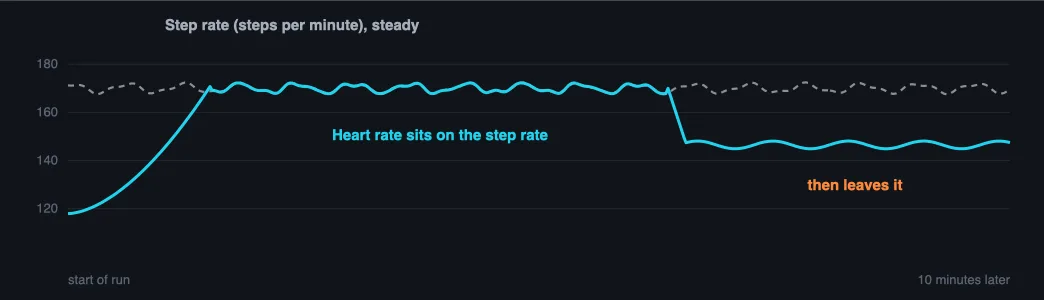
What cadence lock is
Cadence lock is an optical heart-rate error: the sensor reports the rhythm of your steps instead of your pulse. Runners see readings near 170 bpm at an easy effort. DC Rainmaker's review of an arm-worn optical sensor calls it the most common optical error and says it is worse in intervals, and there are plenty of user threads describing the same readings on Garmin watches.
Plenty of forum posts tie it to cold weather, and some users say it sometimes clears later in a longer run. It is an optical problem: a chest strap reads the heart's electrical signal instead of light through the skin, so it fails differently. Most reports involve Garmin watches and arm-worn sensors, so we cannot say how often it happens on other devices.
How to spot it in your data
Three signs together make it likely. The heart rate sits close to your step rate. It barely follows effort: the same number at an easy jog as in a harder stretch. And its edges are abrupt, jumping in seconds, where a real rise is gradual.
Apps show steps per minute, but a FIT file stores running cadence per leg, so compare the heart rate with twice the stored value. During cadence lock the two sit close together.
A match alone proves nothing: runners do reach 170 bpm at 170 steps per minute. A match supports the diagnosis and its absence does not rule it out. The chart is the better check: lock sits flat and snaps, real effort lags and drifts.
What to do about it
One study of a wrist sensor linked occasional outliers to poor blood flow before warm-up, cold weather and gripping the treadmill handles.
If you need dependable numbers, consider a chest strap. In a treadmill study a strap agreed with an ECG reference far better than four wrist devices, especially as effort rose. These studies are small and none measured cadence lock directly, so treat them as pointers, not proof. Straps have their own failures, covered in the guide linked below.
For a file you have already recorded, The Split's Fix heart-rate spikes looks for the abrupt jump and the jump back, lists the stretches it found, and replaces each with an estimate drawn from the heart rate on both sides. Estimates are not measurements. No reading is deleted, lap and session heart-rate figures are recomputed for the laps it touched, and the exported FIT file cannot mark which values were repaired. If it misses a stretch, select a range on the chart and it searches there.

Not every sudden change is an error
Not every sudden change in heart rate is a sensor fault. If readings jump at rest, with symptoms, or keep happening, or you feel unwell, see a doctor. The Split edits data; it does not diagnose.
Questions
- What is cadence lock?
- An optical heart-rate error where the sensor reports your step rhythm instead of your pulse, so an easy run can read near 170 bpm.
- Why does my watch show 170 bpm on an easy run?
- It can be cadence lock, or a real effort. Check whether the number tracks your step rate, stays flat while effort changes and starts and ends abruptly; if it does, a sensor error is likely.
- Can a chest strap have cadence lock?
- Cadence lock is an optical problem. A chest strap reads the heart's electrical signal instead of light through the skin, so it fails differently, mostly through poor contact.
- How do I fix a recording with cadence lock?
- Upload the file to The Split, choose Fix heart-rate spikes, tick the stretches it lists and export. The repaired values are estimates. It can only find locks that start and end abruptly; a lock that lasts the whole file has no edges to find.