Why your heart rate spikes at the start of a run
A wrong but believable reading, 160 to 185 bpm on an easy effort, that snaps back. What causes it, and how to repair the data.
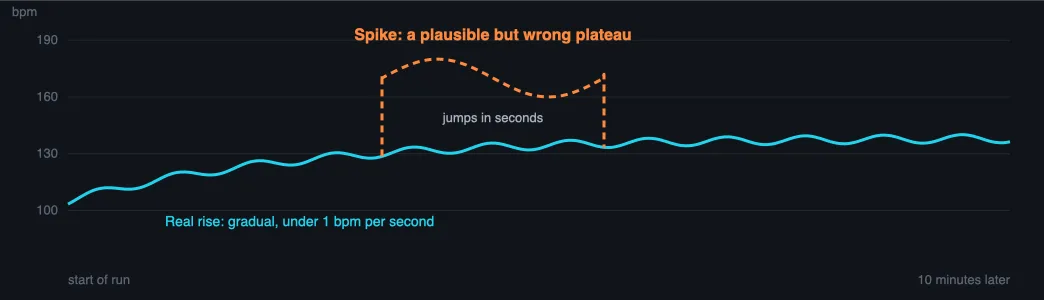
What a spike looks like
Heart rate takes time to move: a real rise into a hard effort is gradual, typically well under 1 bpm per second. A spike does not behave like that. The reading jumps to a wrong level within seconds, holds it for anything from a few seconds to a few minutes, then snaps back. The wrong level is believable, such as 160 to 185 bpm on an easy effort, which is why it is easy to miss.
Common causes, by sensor
Optical sensors, on the wrist or the arm, can be accurate in steady running, but studies still find occasional outliers. A well-known optical failure is cadence lock: the sensor reports the rhythm of your steps instead of your pulse, so you see readings near 170 bpm at an easy effort. DC Rainmaker's review of an arm-worn sensor calls it the most common optical error, and plenty of forum posts tie it to cold weather, such as this Garmin Forerunner thread. Wrist sensors also err most at the start of movement: in a study of 24 young adults, wrist errors were largest when the walk began. These studies are small and use healthy adults, so treat them as pointers, not proof.
Chest straps fail differently. Reviewers describe dry skin, cold or dry air, static from synthetic shirts and worn contacts producing spikes well above 200 bpm in the first minutes, often fading once you sweat, and worn or dirty contacts and old batteries as sources of erratic readings (more from the5krunner). Overall, a treadmill study found a chest strap agreed with an ECG reference far better than four wrist devices, especially as effort rose.
A strap problem usually looks wild: spikes above 200 bpm or erratic jumping. A flat, believable wrong level points more towards cadence lock, the best-documented explanation for it, though we cannot tell you which cause hit your file.
Why a ceiling cannot catch it
Some editors remove every reading above a ceiling you choose. That works for a spike at 230 but not for one at 170: a ceiling low enough to catch it also removes real effort, and the readings at the spike's rising and falling edges stay, because they sit under the ceiling. The Split looks for the abrupt jump instead of a value.
Not every sudden change is an error
Not every sudden change in heart rate is a sensor fault. If a jump came at rest, with dizziness or chest discomfort, keeps happening, or you feel unwell, see a doctor. The Split edits data; it does not diagnose anything.
How The Split finds and repairs spikes
Fix heart-rate spikes looks for the abrupt edges, not for a value. A spike is a fast jump up and, after a plateau, a fast jump back, so the search flags a stretch clearly above the readings on both sides. It looks for upward spikes only, and lists what it found with a confidence label for you to tick.
One slider sets how sensitive the search is, with no thresholds to type. If it missed a spike, select a time range on the chart and it searches there; a range holding several spikes repairs each one on its own.
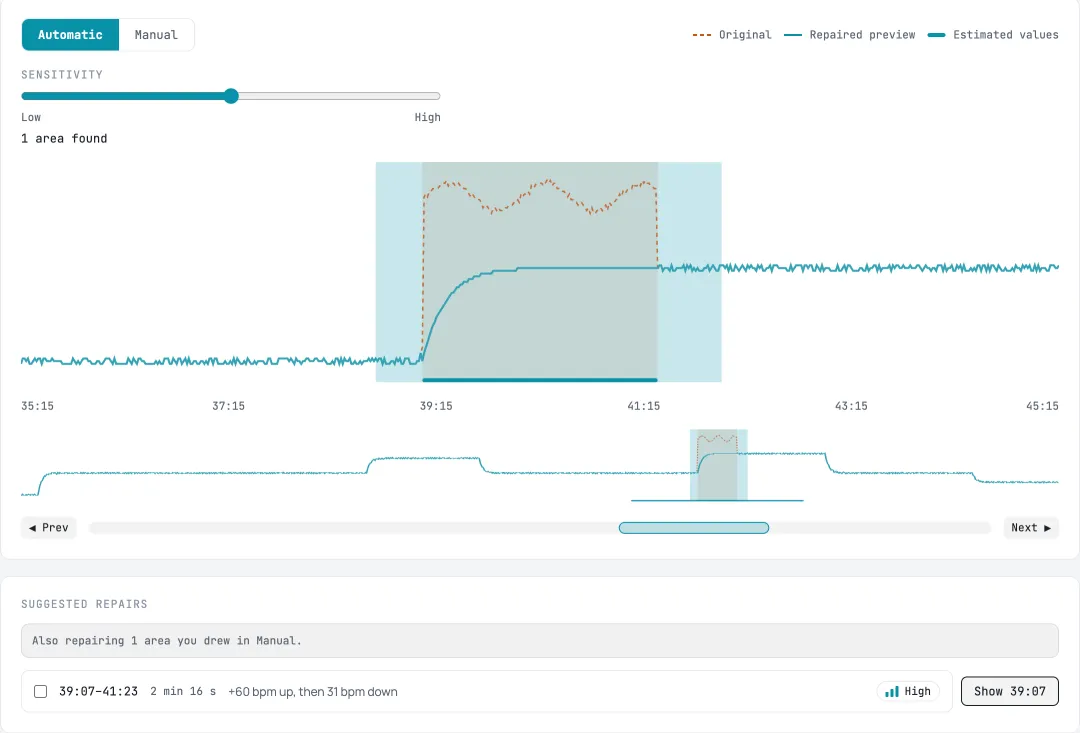
Repaired values are estimates, not measurements. The tool draws a curve from the heart rate just before the spike to the heart rate just after it, mimicking how a heart responds to effort: moving quickly at first, then flattening out. It is an educated guess, not what your heart did, and it is rougher for a spike at the very start or end of a file, where there is only one side to work from.
No heart-rate reading is deleted: each reading in a repaired stretch gets an estimated value, a dropout stays empty, and readings outside the repaired stretches are unchanged. Lap and session heart-rate figures are recomputed for the laps the repair touched, and figures built from the old heart rate, such as time in zones, are removed. The exported FIT file cannot mark which values were repaired, so the preview is the only place they are flagged.
Limits: it cannot find a reading that is simply wrong from the start with no jump, a spike right at the start or end of a file may need drawing by hand, and a recording that logs heart rate only every few seconds gives it too little to work with.
Questions
- Why does my heart rate spike at the start of a run?
- Common causes are a wrist or arm sensor locking onto your step rhythm, dry or cold skin and static under a chest strap, or worn or dirty strap contacts. Strap trouble is described as most common in the first minutes, before sweat helps contact. The file alone cannot show which one it was.
- Why does my Garmin show heart-rate spikes?
- A Garmin file records whatever the sensor reported. Plenty of threads and reviews describe the same optical and strap causes on Garmin watches, including cold-weather reports on the Forerunner 935.
- Is a sudden jump always a sensor error?
- No. If it came at rest, with symptoms, or keeps happening, see a doctor. The Split edits data and does not diagnose.
- Can I repair a spike in a FIT file I already recorded?
- Yes. Upload it, choose Fix heart-rate spikes, tick the stretches to repair and export. Repaired values are estimates.