How to fix a heart rate spike on a Garmin watch
Your Garmin logged a wrong but believable heart rate. How to repair the file, and what to change so it happens less on your next run.
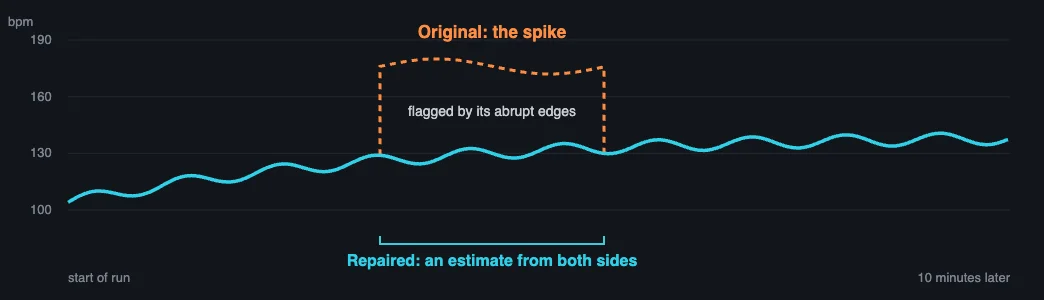
The short answer
A heart-rate spike is a stretch where the reading jumps within seconds to a wrong but believable level, holds it, then snaps back. A Garmin watch records whatever its sensor reports, so the spike is in your FIT file. You cannot undo it on the watch, but you can repair the recording: upload it to The Split and use Fix heart-rate spikes.
What caused the spike decides what to change next time, and the file alone cannot tell you. Why your heart rate spikes at the start of a run covers the causes, and What is cadence lock? covers the watch reporting your step rhythm instead of your pulse.
How to repair the spike in your file
Upload the FIT file, choose Fix heart-rate spikes, and it lists the stretches that look like spikes, each with a confidence label. Tick the ones you want repaired and export. Each ticked stretch is replaced by an estimate drawn from the heart rate just before and just after it, mimicking how a heart responds to effort.
One slider sets how sensitive the search is. If it missed a spike, select a time range on the chart and it searches there; a range holding several spikes repairs each one on its own.

Repaired values are estimates, not measurements. No heart-rate reading is deleted: each reading in a repaired stretch gets an estimated value, a dropout stays empty, and readings outside the repaired stretches are unchanged. Lap and session heart-rate figures are recomputed for the laps the repair touched, and figures built from the old heart rate, such as time in zones, are removed. The exported FIT file cannot mark which values were estimated.
Limits: it cannot find a reading that is simply wrong from the start with no jump, a spike right at the start or end of a file may need drawing by hand, and a recording that logs heart rate only every few seconds gives it too little to work with.
Fewer spikes on your next run
For a wrist sensor, Garmin's own tips for erratic heart rate data include wearing the watch above the wrist bone, snug but comfortable, cleaning and drying your arm and keeping sunscreen and lotion off it, rinsing the watch after workouts, and warming up for 5 to 10 minutes first, indoors if it is cold. One study of a wrist sensor linked occasional outliers to poor blood flow before warm-up, cold weather and gripping the treadmill handles.
Chest straps fail differently. The equipment reviewer DC Rainmaker lists dry air, synthetic shirts, wind and electrical interference as the usual causes of strap spikes, and says that in most cases wetting the strap, with water or heart-rate gel, fixes it.
If you need dependable numbers at hard efforts, consider a chest strap. In a treadmill study a strap agreed with an ECG reference far better than four wrist devices, especially as effort rose. These studies are small and none measured cadence lock directly, so treat them as pointers, not proof.
Not every sudden change is an error
Not every sudden change in heart rate is a sensor fault. If a jump came at rest, with dizziness or chest discomfort, keeps happening, or you feel unwell, see a doctor. The Split edits data; it does not diagnose anything.
Questions
- How do I fix a heart rate spike on my Garmin?
- You cannot change it on the watch, but you can repair the recorded file. Upload it to The Split, choose Fix heart-rate spikes, tick the stretches it lists and export. Repaired values are estimates, and the repair fixes the recording, not the sensor.
- Why is my Garmin heart rate not accurate?
- Wrist sensors can be accurate in steady running, but studies still find occasional outliers, linked to poor blood flow before warm-up and cold weather. Chest straps fail differently, mostly through dry skin and poor contact.
- How do I stop heart rate spikes on my Garmin next time?
- Wear the watch snug above the wrist bone, keep your arm and the sensor clean and dry, and warm up first. For hard efforts a chest strap is the better bet, and a strap that spikes is often fixed by wetting it.
- Is a sudden jump always a sensor error?
- No. If it came at rest, with symptoms, or keeps happening, see a doctor. The Split edits data and does not diagnose.